
Create and Edit Hunt Lists
Use this page when creating a new hunt list or editing an existing hunt list from Configuration > Hunt Lists.
The form screenshots below are separated by block where the application exposes separate sections. Complete the required values, review routing or destination references, and save the record.
Add and edit form
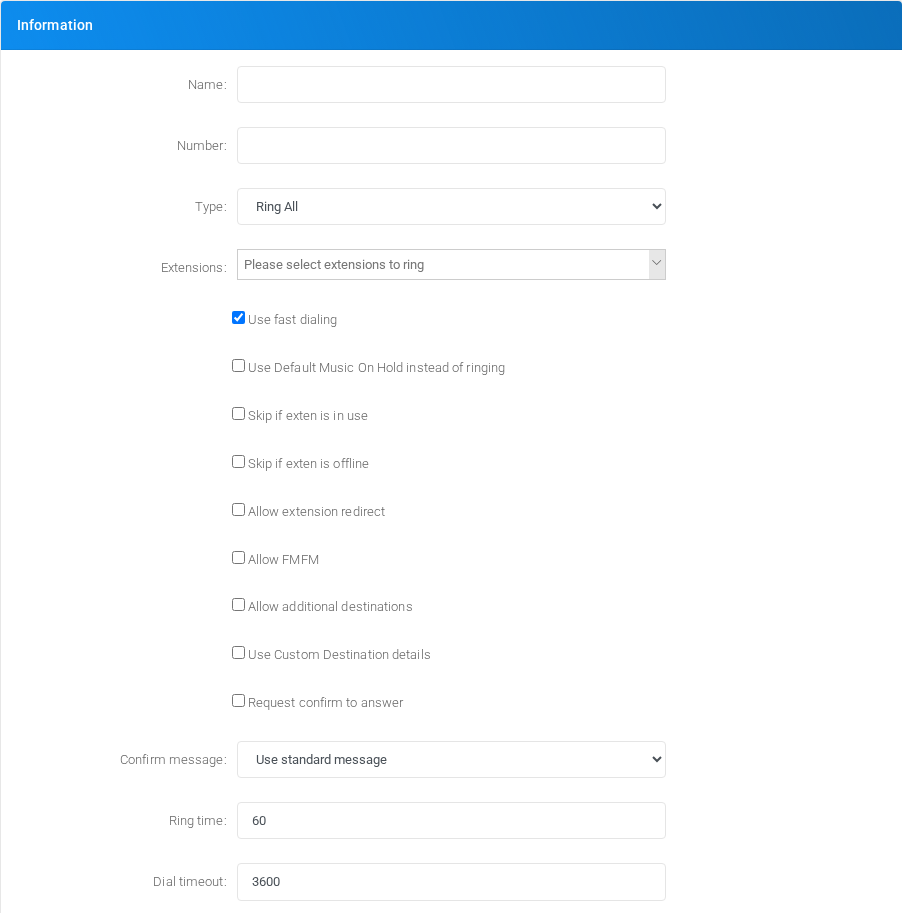
Main fields
| Field | Description |
|---|---|
| Name: | Display name used in lists and references. |
| Number: | Dialed value, identifier, or matching value used by the PBX. |
| Type: | Mode selector that changes the behavior of the object. |
| Use fast dialing | |
| Use Default Music On Hold instead of ringing | Object setting shown by the form. |
| Skip if exten is in use | Object setting shown by the form. |
| Skip if exten is offline | Object setting shown by the form. |
| Allow extension redirect | Target or routing selection used when the object sends a call or message onward. |
| Allow FMFM | Object setting shown by the form. |
| Allow additional destinations | Target or routing selection used when the object sends a call or message onward. |
| Use Custom Destination details | Target or routing selection used when the object sends a call or message onward. |
| Request confirm to answer | Object setting shown by the form. |
| Confirm message: | Object setting shown by the form. |
| Ring time: | Object setting shown by the form. |
| Dial timeout: | Timing value used by the service. |
Fast dialing
Enable Use fast dialing when the hunt list should call the selected destinations directly instead of sending each member through the full extension destination handling. This is useful for straightforward hunt lists where the goal is to ring the listed devices with less intermediate routing logic.
Saving and deleting
| Task | How to do it |
|---|---|
| Create | Select the new action from the Hunt Lists list, fill the required fields, and select Save. |
| Edit | Open the existing hunt list, update the needed fields, and select Save. |
| Delete | Before deleting a hunt list, check call-flow, destination, schedule, report, provisioning, or integration references. Use the row delete action or the form delete action when available, then confirm. |